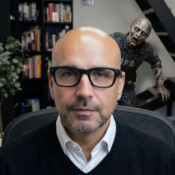
Marcos Hernández is a self-taught video game programmer from the 1990s generation. He started out with an MSX Sony HitBit at the age of nine, moved on to a Philips VG-8235 MSX2 —where he made the jump to assembly with Ramón Sala's RSC-II— and from there to the PC.
At seventeen, in 1993, he took the step into professional development. His first training stop, lasting five or six months, was at Pixel Tecnoelectrónica, where he learned PCB design with Tango, PIC 12 microcontrollers, EPROM, and embedded systems development alongside Antonio Losada. From there he moved on to Ecogames, in a former greengrocer's shop converted into a studio in Sabadell Nord, where between 1993 and 1995 he worked as a programmer on Salvador Casamiquela's (GAMART) NEC V30 board on Twins, LineUp, and Speed Fight. In April 1995, together with Xavi Artigas and Jose Luis Sánchez Romero, he joined Proyesel (Viladecans), where he authored the engine and game logic of Action Hollywood in Motorola 68000 assembly.
After leaving Proyesel at the end of 1995, he stepped away from arcade development and made the move to 3D from the back room of Pixel Informática —Antonio Losada's shop in Barcelona, where he spent two and a half years— together with Jose Luis Sánchez Romero. There he worked with Direct3D, OpenGL, and Glide on the first 3dfx Voodoo cards, and got involved in the development of Chris Egerter's Power Render engine, writing export tools and "lightmap" and "shadowmap" generation routines for 3D Studio Max. Those tools eventually opened the doors of Crytek, where he took part in the lighting and data processing of the first Far Cry. In between, on 1 December 1997, he joined Jose L. Sánchez and Xavi Artigas at Nova Desitec, by then focused on the prize-machine market.
A constant throughout his career has been building tools that speed up the rest of the team's work, present from his earliest days at Pixel Tecnoelectrónica through to his 3D period.
Following the publication of Diario de un desarrollador de juegos arcade, his autobiographical section within Javier Sancho's book, he has entered a preservation phase: recovering whatever source code still survives from those years, releasing it under free software licences, and working to get the arcade versions running in MAME and the PC versions in DosBox-X, documenting the whole process in as much detail as possible.
See automatically generated biography by DeVuego
Marcos Hernández «Optimiza» (
Barcelona,
1976) is a spanish video game developer and writer.
As a developer his most common role is Programmer. He has participated in four spanish video games, among the most recent Speed Fight (EcoGames, 2026), where he took part as Programmer, Action Hollywood (Proyesel, 1995), where also he took part as Programmer, and LineUp (EcoGames, 1994), where again he took part as Programmer.
As a writer he wrote one book about video games, specifically La Edad Oscura del videojuego español de los 90 - Vol 2 (Autopublicado, 2026).
You can know more about Marcos Hernández «Optimiza» visiting his LinkedIn.
This biography has been automatically generated by DeVuego from the information stored in its database, so it may be incomplete.